
Why’re you drinkin’ like the night is young
Why’re you drinkin’ like the night is young
The kids are in the bed and the day is long done
So why’re you drinkin’ like the night is young
— Holly Williams
Searching for a new perspective for enjoying the experience of dining without booze
There is a material difference between the prosaic act of eating and the sensual pleasures of dining. One is a basic requirement for human survival, while the other is a journey into a world of flavors, textures, and techniques, which, in the right hands, combined with the generous spirit of hospitality, produce a sort of cultural alchemy, yielding something more precious than gold.
All eat, after all, but very few take the time to dine.
We are too busy, distracted, or broke to think about food as something other than simple nourishment, a necessary source of energy to keep the body’s furnace burning and light in our eyes. If you’re eating at your desk or in the car, no matter what it is, you’re just filling your pie hole and doing little to nourish your everlasting soul.
It need not be fancy, to be elevated, but the fare must be of the finest ingredients, according to the traditions of the dish, and revered and respected both by the one preparing it, as well as the one consuming it. It’s a sharing of kindness by strangers, connected by something deep and emotional in our collective past; a communion, an edible talisman made with passion and craft, and shared between lost souls.
It’s bewitching.
Food is a romantic subject to me, much more so than love. Some writers wax poetic about sweethearts, sunsets, flowers, heroes, mountains, or trees. I romanticize food. I’ve never in my life written about romantic love or longing, but have written ad nauseam about all manner of edible delights and my memories of them, and desires for them.
I have written entire treatises about French fries, and elaborated at length on the simple pleasures of Neapolitan pizza. I’ve traveled to all manner of far-flung locales and managed to bring back little more than stories of meals I ate, the flavors embedded in my psyche till the end of my days. But recently, I have discovered I have a problem. I can’t really drink anymore, and believe it or not, the drinking isn’t the problem.
The prospect of enjoying dining without alcohol is a problem, because a glass or two of wine has always been half the fun of going out to eat. It wasn’t the only point of dining out, mind you, but it was certainly a significant part of it. A buttery glass of Chardonnay was something to enjoy while you waited for your food or the check. It greased the wheels of companionship and filled in the lulls and gaps in conversation. It was the glue that held the whole mess together.
There is a certain euphoria in that first glass of wine that makes all your worries disappear, and puts you right with the world. Alcohol smooths off the rough edges of awkward social interactions, poor table service, and subpar food. When I dine out without the benefit of alcohol, I’m more critical and less patient. I’m rarely relaxed — sitting on pins and needles, hyper-aware and skittish, tapping my fingers in nervous anticipation.
The meal becomes transactional, less transcendent. I’m just eating for the sake of eating, and when it’s over, I’m almost always disappointed. Everyone and everything suddenly becomes slightly to moderately annoying, and the minute I’m done, I’m looking for the check and ready to leave. There’s no point in lingering at the table without a drink to finish. Even coffee, which I love, loses its allure. Without alcohol, dining becomes eating, and eating becomes a task to finish rather than a pleasure to savor.
I haven’t quite been able to get past this — so far — but I’m working on it.
I can’t tell you the number of times that I’ve had an alcoholic drink because it was something to do and I was slightly bored. It wasn’t a deep desire to escape, fit in, relax, or even celebrate. It certainly wasn’t about getting drunk, and I rarely ever was. It’s just what came next. When nothing else of importance was going on, you might as well have a cocktail. I could rationalize a drink at any time of day or night, not because I needed it but simply because I could handle it.
I’ve finally had to stop drinking regularly because the aftermath became unbearable. It had nothing to do with my life becoming unmanageable due to inebriation or anything that dramatic, but because of the physical distress it caused me. The hangovers became debilitating, without ever having gotten drunk, accompanied by paralyzing anxiety. I would be forced to muscle through it, even when it was caused by only a few drinks. A glass or two of wine at lunch was fine, but if I made the fatal mistake of continuing at home later that evening, even just another drink or two, it would continue for a few days or weeks, and eventually I’d be completely wrecked.
I found that with my self-employment status being so precarious and dependent on my ability to impose whatever success I might find through sheer force of will, I needed every ounce of mental fortitude and emotional stability to keep the train on the tracks and moving forward. I simply couldn’t afford to be undermined by the dubious uncertainty of anxiety and brain fog. I couldn’t bear the physical distress and lack of mental acuity.
I have no intention of never drinking again, but I now fully realize the costs, and it has to really be worth the pain for me to consider partaking. It’s no longer a casual pleasure I can take for granted like so much of the world seems to be able to. It’s a bloodletting, and there’s only so much damage you can inflict on your mind and body before it begins to resist and fail you. Sure, I can have a drink now and again, but I either have to force myself to stop immediately thereafter or consider it a short “bender” and accept that I will pay dearly for the excursion.
It’s so rarely worth it.
I’ve written my fair share of restaurant reviews, both paid and voluntary. Unless I’m being contracted to do so, I generally don’t bother unless it’s either stupendously good or spectacularly bad. You have to literally drive me to madness before I will write about your food, because you’ve blown my mind by how transcendent or decrepit the experience. I don’t enjoy trashing any restaurant, as it’s incredibly difficult to run even a bad one.
I challenge you to manage a McDonald’s for an afternoon, let alone a Michelin-starred fine dining eatery for a fortnight. None of it’s easy. Still, sometimes, you have to challenge even good restaurateurs and chefs to do better, or at least save your fellow diners from the travesty of culinary disasters.
That said, it’s not an answer to my current dilemma. In fact, I would go so far as to say that until I get my head together, I shouldn’t be giving anyone a bad review. It might not be an entirely fair reflection of the product and service before me.
I’ve always loved reading the work of the great 20th-century food writers such as MFK Fisher, Calvin Trillin, RW Apple, Jim Harrison, AJ Liebling, and, more recently, Anthony Bourdain. Most of their best work was not criticism, per se, but an exaltation of the best cuisine America had to offer. Their writing inspired us to expand our horizons, as well as our palettes, and more often than not, they made us laugh in the process.
This has given me an idea, a sort of mental fidget-spinner to keep my monkey mind from getting out of control while in the simple process of eating a meal. I’ll take copious notes during each meal and find something worth writing about that doesn’t have anything to do with the restaurant itself, unless it’s good. I’ll write about the experience of food, and do my utmost to find the silver lining. There’s almost always something, a dish, a detail, a flavor. Something.
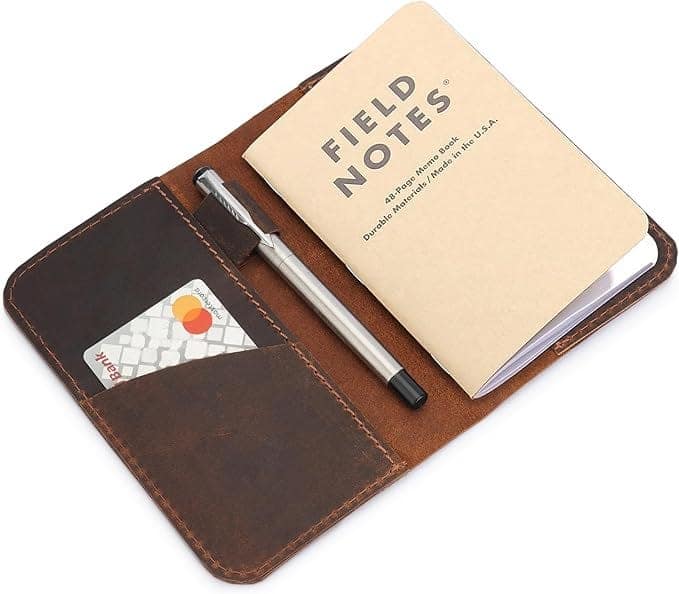
I even bought a new pocket-sized leather folio that holds a 3×5” Field Notes® and a mechanical pencil. No iPad and no large journal. Just a little notepad and a pencil. This is not required, of course, but sometimes I need a little extra motivation, and a small purchase can be enough to spur me forward. Maybe it will bleed over into other things.
As Holly Williams, the granddaughter of Hank Williams, once sang, “Mama took the kids, and the money’s all gone…Hope we don’t die drinkin’ like the night is young.”
The night, it turns out, is not as young as it once was.
Follow David Todd McCarty on Mastodon.