
Maybe more impactful than the faceless throng in the streets chanting pre-packaged slogans is the solitary protestor, earnest, vulnerable, and alone
Originally published January 2023
It pops up from time to time on your social media feed, a picture or a video, of the lonely protestor, an army of one, standing on a street corner, or the sidewalk of a quiet neighborhood, standing silently, with a hand-drawn sign and a look of earnest determination.
We are drawn to this image precisely because it evokes strong emotions within us. We can all imagine how hard it can be to make that decision without the support of another kindred spirit, without even a friend to egg us on or a community to rally beside us.
To find that piece of cardboard, maybe from a salad spinner we got from Amazon, a marker from the junk drawer, some tape from the garage, and then craft your own, sad, little sign. You leave the comfort of your own home, walk outside, and stand on the side of the road, hoping for the horn of support, but expecting the shouts of ridicule.
The lone protestor cannot melt into the crowd or hide behind the more gregarious voices of extroverts. The lone protestor not only stands apart, but they represent a single idea in the form of a human being, dressed in whatever they’ve chosen, looking however they look. They have no armor to protect themselves. They wear denim and sneakers, and their hair they can’t control. They are who they are, and they stand before you—vulnerable.
And because they are vulnerable, we have more reason to listen to them. They are not intimidating. They are not threatening. They are not in a position of strength. They are pleading for our attention, and we are apt to give it to them.
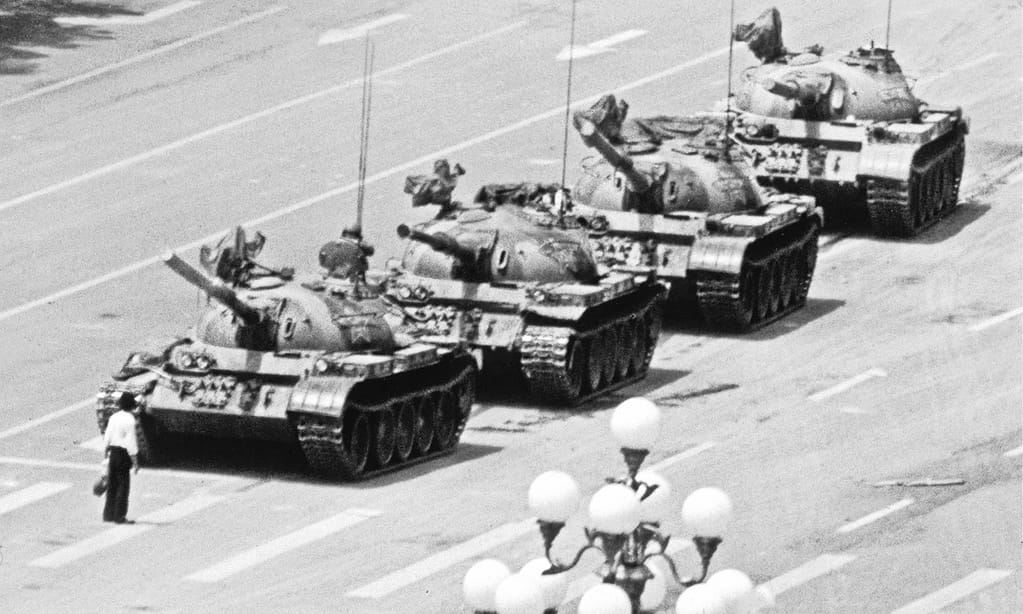
It was, after all, the visual of a single man standing up to a line of tanks in Tiananmen Square that became the symbol of resisting tyranny in China. It was Greta Thunberg, a 15-year-old Swedish girl, who sat outside Parliament all alone until the world rallied around her. It was Ieshia Evans wearing a dress on the streets of Baton Rouge, being arrested by police officers dressed for war.
The image of the single protestor is powerful stuff.
Guerrilla warfare is a form of irregular warfare in which small groups of combatants, such as paramilitary personnel, armed civilians, or irregulars, use military tactics, including ambushes, sabotage, raids, petty warfare, hit-and-run tactics, and mobility, to fight a larger and less mobile traditional military. It is a tool of the weak, effective against the tyranny of the powerful.
In Guerrilla Protesting, the objective is the same, although the tactics differ. The goal is to take advantage of speed and agility and to remain mobile, using hit-and-run tactics to ambush the public and institutional targets, in order to create the illusion that the forces you see represent a much larger force that you may not see.
It is, in essence, a strategy to divide and conquer. Every group can amass a larger counter-protest if they have the time and the resources. But when you are a protestor of one, your power is that you have no power. For a group to come together and shout you down is to appear as the bully.
A single protestor, standing alone, is a more powerful statement than 20 people standing together. This seems counterintuitive, but it’s true because culturally, we know how hard it is to stand alone, and we give more credit to that one person than we do to the 20.
So if you have 20 people willing to protest, you have 20 powerful protests in 20 different locations, instead of one. If each demonstration lasts 30 minutes, and you do three protests each, you will have achieved 60 protests in about 2 hours. Sixty protests in two hours, in a somewhat defined space such as a small town, will have a much more significant impact than 20 people standing in front of City Hall for two hours.
Guerrilla protesting is actually not a solitary act, as it requires two people. One person is designated the Protestor. The other is the Witness. The Protestor remains silent at all times. Never speaking back, no matter what. The Witness is there to document the protest using photos and video, and to ensure the Protestor’s safety. If necessary, the Witness may speak for the Protestor, to curious people, or to the police.
A single protest should take no more than 30 minutes in a single location. The idea is to stick and move. It is most effective when protests involve at least three locations, but can extend as far as you’re willing to go. Effectively, all locations do not need to be in high-traffic areas as one might expect. The visual of protesting in the middle of nowhere is powerful stuff and should be considered as important as in the center of town.
While not an effective strategy for campaigning for a particular candidate, it can be very effective for opposing a candidate. A negative comment, presented alone, can stick in a way that a campaign poster, or a parade of protestors, never will.
A few years ago, when flash mobs were all the rage, we all watched, enthralled as an entire train station would erupt in seemingly spontaneous song. The cameras would capture the bystanders, in surprise and awe at the spectacle. All ten of them.
Because the thing about these types of staged events is that they were not about the live performance. They were about the video record. They were not done for the benefit of the actual witnesses, but for the millions who would later watch the carefully edited video on their phones in the comfort of their homes.
This is why public protests are only as effective as it takes to be newsworthy. If you can get the news media to cover your rally, it matters less how many protestors show up, but in how many are influenced by the reporting. The difference between 10 protestors and 20 protestors is virtually meaningless. At the same time, it might be relevant if 1000 show up instead of ten, but only to indicate how important the event is perceived to be.
If you can get the same reaction from a single protestor, or a plague of single protestors, you have increased not only your visibility, but the chances of your protest reaching a receptive audience.
This is not to say that there is no time and a place for massive protests, or even small groups, but that there is more than one way to voice your displeasure with the status quo, and we should use every tool available to us to disrupt the system. Doing the same thing over and over, not only becomes background noise it also becomes easier to combat.
The beauty of a guerrilla resistance is that when they don’t know where you are or what you’re going to do, it’s harder to gather their forces against you. The strength of insurgency is never to do what they expect you to do. It is organized chaos, using orchestrated attacks that appear random and out of nowhere, to inspire questions concerning the establishment and resistance to the status quo.
But the most extraordinary power in this idea is that, technically, it only takes one person willing to stand up and silently voice their displeasure. But if one person joins them, and then another, and still more, you may begin to tip the scales in your favor. So begin with yourself.
You are the one.