
Enshittification (n): 1. The degradation in the quality and experience of online platforms over time, due to an increase in advertisements, costs, or features. 2. Any state of deterioration, especially in politics or society.
The rewilding of our digital presence and a return to a simpler approach to an interconnected community
I believe that we have lost our way.
We have lost it as a society, as a culture, as a people, and a rewilding of our society is not only necessary for survival, but inevitable. This is, no doubt, not a controversial opinion. We’re all quite aware that something is terribly off and can’t possibly continue on its present course, but we’re not sure what to do about it. I’ve been on a journey to replace the enshittification of my online experience with a return to authentic, analog experiences that have the power to sustain and inspire, and I’d like to share some of my thinking with you here.
As a population, we have been lulled into a false sense of community because we have this gizmo in our pockets that beeps, vibrates, and flashes light at us, and we have confused this blinking monstrosity with a meaningful life and a strong sense of community. Instead of being more connected with the world, we are increasingly more isolated, anxious, and depressed than ever before. It’s even worse for the younger people who have no other reality or frame of reference with which to escape the insanity. They have no firewall.
Clearly, this is unsustainable.
The Internet Is Bad
Not long ago, I came across a website titled, “A Website To Destroy All Websites: How to win the war for the soul of the internet and build the web we want.” That’s a pretty heavy title for something artfully prepared and presented, but it really blew me away. Both in concept, content, and execution. It was elegant and straightforward, impactful and informative, simple and complex. It was a revelation, at least for me, not so much for what it said, but what it represented. A new way of thinking that was actually quite old-fashioned.
The entire website itself is a single scrolling page of design, typography, and imagery that weaves a story of rediscovery and an alarm of warning. The central message is to encourage people to abandon the Frankenstein monster we have accepted as our sole means of socialization, and to take back control of our lives, at least the digital versions. I’m not sure if I buy into his plan fully, as stated, but I wholeheartedly endorse his worldview and the problems we’ve created for ourselves.
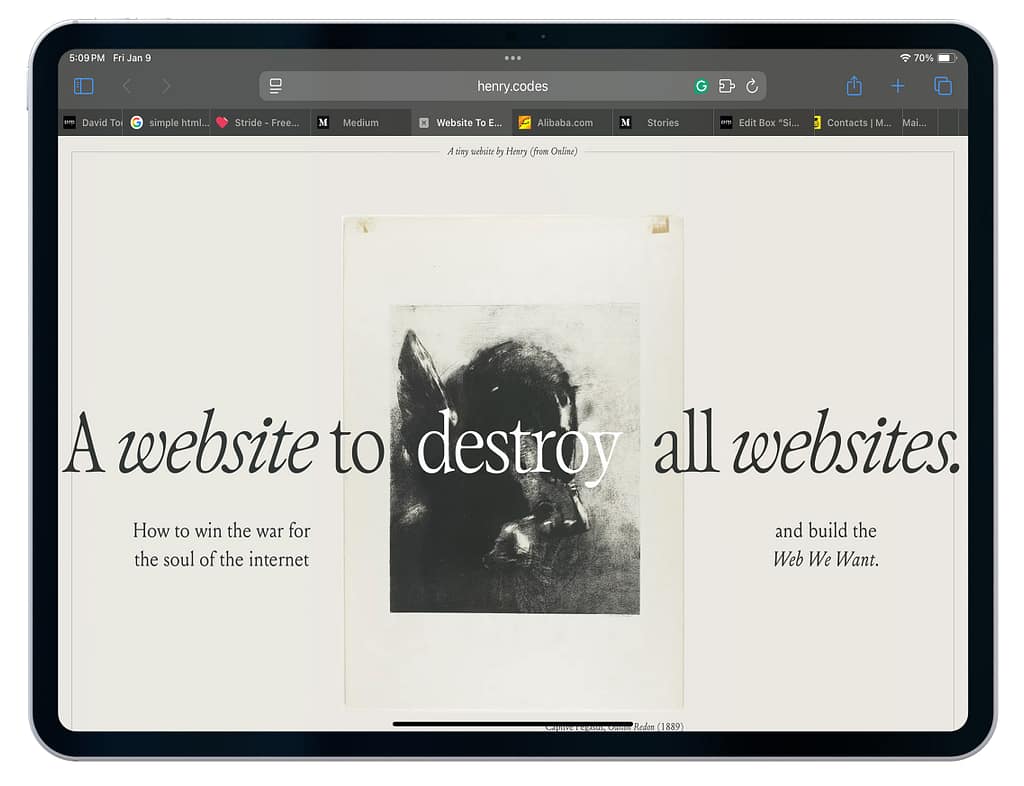
“The internet is bad,” the author known only as Henry begins. “Well, the Internet mostly feels bad these days. We were given this vast, holy realm of self-discovery and joy and philosophy and community, a thousand thousand acres of digital landscape on which to grow our forests and grasslands of imagination, plant our gardens of learning, and explore the caves of our making.
“But that’s not what we use the Internet for anymore. Instead of using it to make ourselves, most of us are using it to waste ourselves: we’re doom-scrolling brain-rot on the attention-farm, getting slop from the feed…. Our powerful drive to learn about ourselves, each other, and our world, is broken into scant remnants — hollow, clutching phantasms of Content Creation, speed-cut vertical video, listicle thought-leadership, rage-bait, and the thread emoji.”
Henry goes on, and you can likely guess the rest, but you should read it for yourself. He makes a pretty compelling case for how we got here. The question is, what do we do about it, and this is where it got interesting for me. Henry’s answer? Personal websites, built with simple HTML, featuring content you create for yourself and others, then syndicated to the world using tools as simple as RSS. It’s not earth-shattering, but it makes a lot of sense. Keep it simple, stupid.
I’m not sure that Henry has discovered the answer to all our problems, though he’s a talented designer with a strong sense of style and solid grasp of the language. That does not exactly describe most people in the world, and many of us who are designers, writers, or artists of other sorts are not necessarily capable of coding our own websites. But it did make me think about the future of the internet in the face of all this slop. Authentic, independent, personal websites, individually crafted and imbued with personal content and style, could be just the ticket for what ails us. At the very least, it’s a better use of our time, and if we become motivated to seek out others doing the same thing, it could develop into quite an interesting community.
A Digital Orphan
They say home is where the heart is, and I suppose that’s true enough. There’s the old adage about the two wolves who live inside us and fight for control of our souls, the winner ultimately being the one we feed. We are what we seek and what we give agency to. For a long time, home was where I slept, but work was where my mind remained. My identity was so entangled with my job that my work address was just as important as my home, and my work email was more often the primary choice. I existed as an extension of a brand I had no control over. Clearly, not a great position to be in.
For just shy of three decades, I worked for an international branding agency where I was a Partner and Director of Branding, until I left and started my own consultancy. I had long maintained a side business, complete with a brand, website, business cards, and a social media presence, but it had largely been there as a catchall for my various creative ventures and freelance projects. It was my sandbox, but never a serious venture.
After I decided that my best option was to go out on my own, I spruced it up and made it my new home base (hoppingfrogstudios.com), but it remains somewhat stagnant and fixed because of the nature of the work I do, which is often deep strategy and not necessarily for public consumption. I often can’t show the real work I’m doing because it’s proprietary to the client. My website is simply the company brochure, and not a dynamic expression of my life, as it should be.
I have also owned the domain of my name for a long time (davidtoddmccarty.com), but have never really focused on it or spent much time and energy on it, relying instead on my work to give me an identity. There was always something there, usually a blog, or maybe a link tree, a repository for all my other shenanigans, but it was never a primary focus, and I’m sure I rarely saw any traffic. It was more of a placeholder. But lately, I’ve begun thinking about transforming it into my forever home, a place to nest and get comfortable in the digital world. A place entirely within my control.
Technically, I have active accounts on Facebook, Instagram, Threads, Tumblr, Reddit, and Bluesky, but I’m rarely, if ever, on them. I occasionally go on Instagram for work, but otherwise, I do no regular check-ins or post to any of these accounts. I keep them for business purposes and do zero socializing on them. In most cases, I no longer even have the associated apps on my various devices.
My sole remaining social media platform is called Mastodon, which is part of the Fediverse, an open-source, decentralized network that is community-run and volunteer-managed. Mastodon is essentially a microblogging platform similar to Threads or Bluesky, but without the corporate manipulation or Nazi parades. It’s like Twitter for liberal/anarchist nerds, and is comprised of a series of independent servers that connect using a common protocol. Most of the servers have fairly small communities and are moderated by actual humans who keep out the riff-raff, bots, and ne’er-do-wells.
One of the biggest differences with Mastodon, compared to any of the corporately-owned platforms, is that it’s authentically linear, with no algorithm feeding you posts or users it decides you might like. It’s a straight, linear timeline of posts from people you purposefully follow, and nothing else. There are no promoted posts, no advertising, and no call backs. If you follow three people, you’d better like them and hope they post a lot, or you’re going to get pretty bored very quickly. I follow about a thousand people and have about 4800 followers. People come and go, but that seems to be plenty to keep a healthy amount of content around to sift through and entertain.
Unfortunately, I made the decision to switch over to Medium’s Mastodon server a few years ago. At the time, I believed there might be some ancillary benefits or at least some unique integrations, and the cost of the server was being taken care of by my membership, but I was mistaken. I needed to make a move, so recently, I did just that. I lost about 600 followers in the move, but that’s the price you pay for freedom.
The Rise And Fall Of Medium
I joined Medium in March of 2020. Someone on Facebook had suggested I publish there, but at first, I thought they were just sending me to another blogger platform, which I didn’t need or want. I signed up for a free account and posted a few things, but didn’t think much of it. It would be another year before I would consider it a real option and begin paying for a membership. When I finally did, it took another year of regular posting, but I began to get a little traction, discovered publications, which were still a going concern back then, and I even began making a little scratch. A few hundred dollars here and there.
Eventually, I would start my own publication, Ellemeno (LMNO). It was just me for a time, and then others joined. Natasha MH had followed me over from Facebook to Twitter to Mastodon, and she began writing for LMNO until I finally asked her if she wanted to be an editor. She accepted and became the face of the publication for many people.
I would ultimately start three other publications: Rome, a political journal; A Bit Dodgy, my attempt at producing a daily column; and Hopping Frog Studios, a blog for my branding consultancy. They all garnered a certain amount of attention, and I began to attract an audience and make some money. At the height of it all, I was publishing an article a day on average and generating $1500/month in revenue, with my biggest month reaching $3,300. I also continued to build an audience, eventually reaching 12,475 followers and 686 email subscribers, and counting.
Last month, due to recent changes in the platform, I made just $83.95. I have a larger audience than I’ve ever had, and yet I am experiencing very low readership and very little revenue. Given that it only costs me $5/month to be a member, you might consider that a fair trade, but not for the amount of work that goes into it.
I’m not going to air all my grievances about Medium here, but I’ll just say that it wasn’t just one thing that drove me over the edge. There was a parade of offenses by management that left a bad taste in my mouth and made me realize I was on the wrong side of things. I was being hustled and paid off in scraps, and the worst part was, they were acting like we were all lucky to be there. If I stayed, I had no one to blame but myself. Fool me once, shame on you. Fool me twice….
The Value Of Personal Websites
Human beings are naturally wired to seek out efficiencies, so it’s reasonable that we would be attracted to aggregators, those platforms such as Cable Television or Facebook, where we can find everything we need in one place. Once these services become enshittified, through consolidation, profit-taking, and the resulting price gouging, we become disillusioned and begin to look elsewhere.
There has long been a movement to abandon corporate-owned media and retreat to decentralized enclaves where individuals own and operate their own platforms, but it’s mostly been the refuge of the techies and anarchists, of which I’m neither. Most people aren’t capable of building their own website, not without a lot of help from an established DIY platform, let alone operating their own server or writing their own code. Still, there are so many resources available to us now, including a treasure trove of open-source alternatives, that with a little effort, most of us can cobble together a decent website without too much pain and suffering.
The question is why?
Two reasons, in my opinion: One, art is integral to a healthy society, and creating art, in any form and at every level, is a subversive act of rebellion. Two, an independently owned and operated website that you create content for is the ultimate defense against enshittification and a bulwark against the tsunami of AI Slop threatening to consume us.
The internet really can connect us, but we have to be present and accounted for to be found. We can grow a community of creators and artists, thinkers and writers, sharing our lives with one another. We do not need to be told what to like or who to follow. We can decide for ourselves. We can present our true selves to the world and invite others to come and see, while we seek others who are doing the same.
A Post-American Internet
Cory Doctorow, in a speech titled “A Post-American, Enshittification-Resistant Internet,” talked about his hope that there had emerged a new crack in the facade of corporate enshittification, one created by none other than Donald J. Trump. This caused Doctorow to say he was now hopeful — not optimistic, mind you — but hopeful.
“Fuck optimism,” he said. “Optimism is the idea that things will get better, no matter what we do, and I know that what we do matters. Hope is the belief that we can improve things, even in small ways, and that we will ascend a gradient towards the world that we want and attain higher vantage points from which new courses of action, invisible to us here at this lower elevation, will be revealed. Hope is a discipline that requires that you do not give in to despair, and I’m here to tell you, do not despair.”
His thesis is that it’s time for the world to break free from American technological dominance and form their own online communities free from enshittification. He makes the point of saying this will be good for Americans as well, which I agree with. Ultimately, we will be the recipients of their goodwill, despite our failure to protect ourselves or them.
A Product Of Our Imagination
We like to think that identity is something we choose rationally, or that it is a product of who we are and how we were raised. The truth is, identity is not biology-driven, but a product of our imagination. We are who we believe ourselves to be, which is nothing more than who we imagine ourselves to be. We are, therefore, just figments of our own imaginations. As one scholar put it, “We are not who we think we are, or even who you think we are, but who we think you think we are.”
We are deeply affected by the world around us. When we connect deeply with a person, brand, product, or service, they become part of our identity. It’s why we have Mac and PC people, Jets and Patriots fans, cat people and dog people, and the like. We think we make logical, fact-based decisions based on qualified research and analyzed input, but mostly we do whatever the cohort says is acceptable and most desirable.
Which is why it’s so important to choose your cohort wisely, and not base that choice on a single, unrelated criterion such as political affiliation, religion, ethnicity, or sexual orientation. We think if people agree with us on one or two things, they must agree with us on all of them, but that’s almost never true. We are complex animals who find ourselves in the middle of a herd, whether we meant to or not.
What we cannot allow is for profiteering corporations to define our identities through complex algorithms designed to fleece us of as much time and money as possible in the guise of building a lasting community. They don’t care about community. They care only about attention and who they can sell that attention to.
The Rewilding Of Our Digital Selves
The answer is to take back control of our identities by defining ourselves based on what we put out into the world and to invite others to do the same. To build personal websites with blogs of writing, portfolios of art, photography, and crafts. To paint and color, doodle and sculpt, type and scratch, our endless stories, dreams, fears, and desires. To imagine an identity we can be proud of, that speaks to us, and relates to others. We need to relearn how to connect with people, both in the real world and online, to use our real names, and become fully-formed human beings in the real world, not some avatar for the digital age.
So, that is what I plan to do.
Create a space for myself in the World Wide Web that is mine and mine alone, where I can experiment and play, and then share with the world. In turn, I will seek out others who are doing the same, and connect and follow them, so I may be moved by their journey as well. Essentially, this is what we imagined the internet was going to be before the tech bros sold their souls to Wall Street for thirty pieces of silver and took us all to hell with them.
I invite you to do the same.
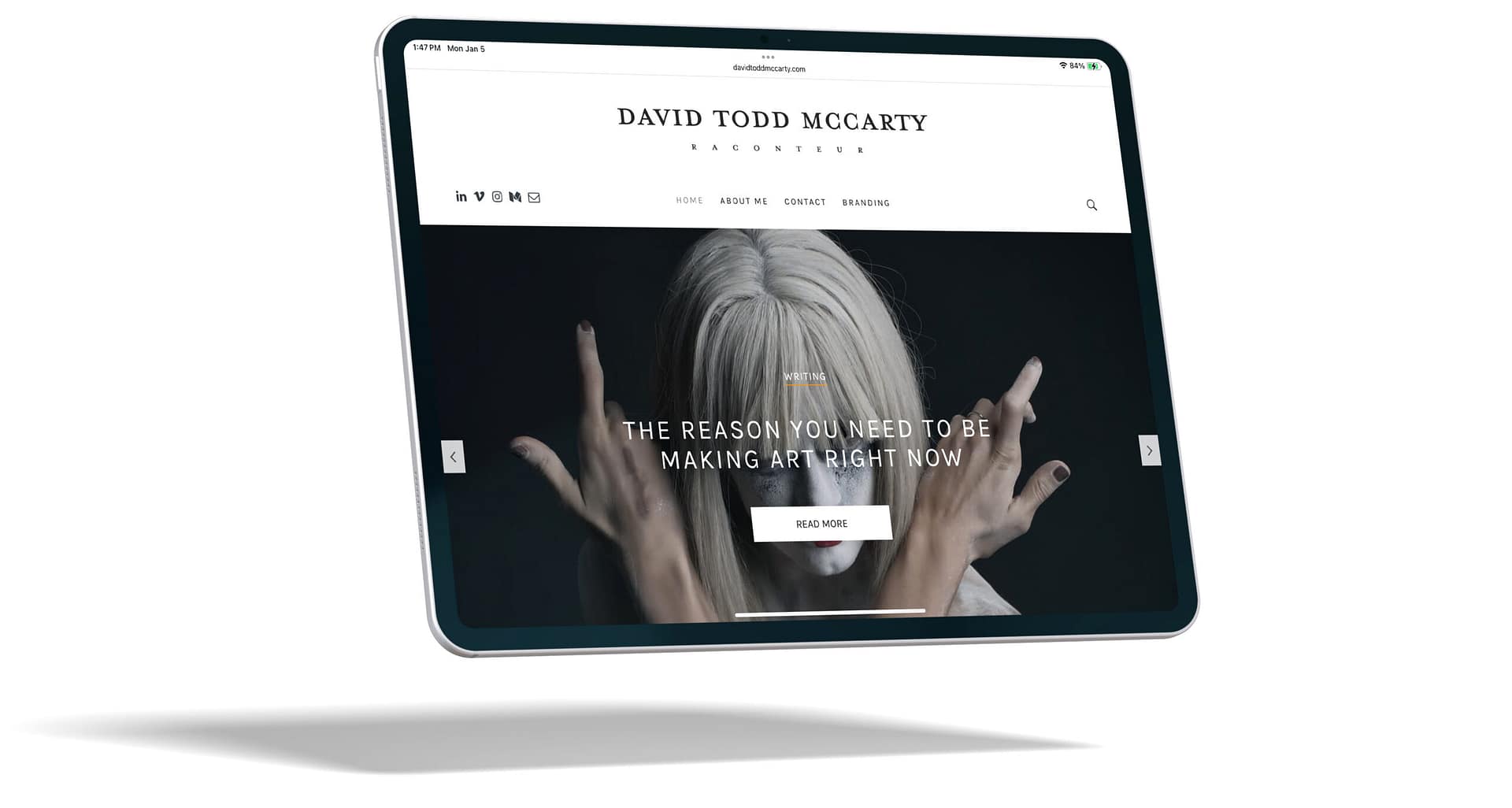
Start a blog, a portfolio, a website. Rent space on a server somewhere and find a simple HTML template you can download for free. Purchase your own domain and host your own email. Take control of your digital self, and build yourself a home you can feel comfortable in. Then invite people to come over and hang out.
I have only just begun, but I invite you to visit my new website at davidtoddmccarty.com. I urge you to sign up for free alerts when new stories are published. No spam. No marketing. No solicitation. No paywall. Just stories. I will be closing down all my other accounts in the next few months, including Medium, so if you’d like to keep in touch, I strongly urge you to sign up and become part of my new community. You can’t beat the price.
Beyond my personal site, I have also been inspired to create single-concept, one-page sites, mostly to amuse myself. I have not yet decided what my first one should be, but I have some ideas brewing. Part web design, part performance art. Simply as an expression of my artistic soul for the entertainment and fulfillment of others.
Please join me.
Follow David Todd McCarty on Mastodon.