
Pooh-Bear, free will, surrender, fear, and our search for freedom on the stream of life
I was talking to my cousin Sean the other day about the meaning of life and our place in it, simply because we’re Irish, and that’s just what we do sometimes. Sean is a very spiritually-minded person, though not what I would call religious. He’s been on a real journey of late, trying to figure out who he really is and what that might mean. Like everyone else, he’s just trying to find his place in the world, but to his credit, he is working rather hard at it.
We don’t talk as often as we should, as he lives in San Francisco and I live in Goshen, New Jersey, but when we connect, there’s a shorthand of family lore, intellectual pursuits, and disastrous personality traits, that allow us to carry on as if we had just spoken the day before. We’re all crazy artists and borderline psychotics in our family, often with a strong taste for the spirits. We feel too much, think too hard, and worry about things beyond our control. We’re Irish — what are you gonna do? Where do you think all that fantastic poetry comes from?
Sean and I were talking about being in a state of flow. He explained that the best way to get out of his own head and the chaos of self was to be of service to someone else. He found that when he was speaking to a friend, one whom he was trying to help stay sober, it was like the words were coming from somewhere outside of himself. That it almost didn’t have anything to do with him. He was merely the vessel through which the words were being poured. This, I understand fully.
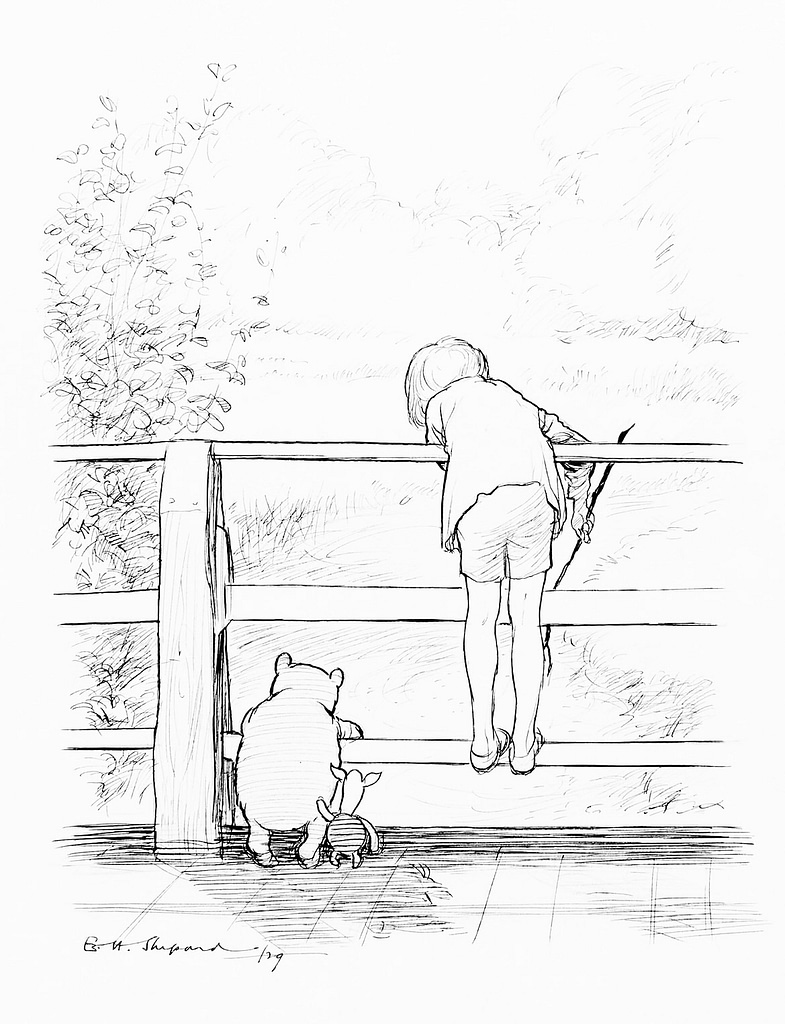
There is an episode in Chapter Six of “The House At Pooh Corner” where the woodland creatures invent a game known as Poohsticks. The rules are simple and straightforward. Participants drop sticks on one side of the little bridge over the stream and then hurry to the other side to see which stick arrives first. It’s a game of chance, although some have argued there is an element of skill involved. Eeyore proved particularly adept at it.
The thing is, the stream is constantly moving whether you play Poohsticks or not. One might argue that the stream isn’t aware the game is being played at all. The stream exists regardless of what games we play on its surface. It has no memory of past events, nor does it worry about the future. It just is. This is life. This is the world in which we live. We are the sticks, rushing by, thinking we have some control over where to go. Believing we can somehow make a difference on the nature of the stream. Only occasionally do we recognize the absurdity of this.
This is the state of flow. Where we lose ourselves in the process and allow ourselves to be divorced from the drudgery of self. We float above it all, and if we’re lucky, we can watch other sticks float by and wonder where they’re going and who will get there first.
There have been many times when I’ve been talking to someone or even writing, and I find myself in a state of flow. My thoughts do not seem to be my own, and I am aware that these are not ideas I’ve had before or thought through. They come to me in real-time and are not the product of intentional analysis or deep thought. They are what we sometimes call instinctual.
I recognize these moments because later on, I’ll have almost no recall as to what I said, even though I believe my words had value and weight.
“What was that thing you said to me?” someone might ask.
“I have no idea,” I’ll tell them honestly. I couldn’t remember if I tried.
I have the same issue with things I have written. I’ll go back later and read them and wonder who wrote them because I not only have no memory of writing them, I don’t even remember thinking about it. Where did that come from?
Sean has been thinking a lot about freedom lately. Freedom from what he calls our self-imposed prisons. Prisons whose doors are wide open but that we refuse to leave because the walls make us feel safe. So many of us are more than happy to stay in our prisons because we are familiar with the walls. We appreciate the routines and rely on someone telling us what to do. What would become of us if we left, if we walked out the door and discovered the world? It’s almost too much to think about.
Sean’s other big word is surrender. He talks about how counterintuitive it is that the only way to be free is to stop fighting and surrender. This is not how Americans have been taught to pursue freedom. We are told we must fight for our right to party. Everything is some sort of epic battle or war. Surrender is failure. What a terrible way to go through the world.
Because we don’t fight. We sit in our cells and complain even though the gates are never locked. Why would we stay when nothing is keeping us from going out and exploring? Fear. Fear is what drives us. Like the people in the Matrix, most of us are too far gone to realize we’re in a prison of our own making, and the prospect of venturing out is simply unthinkable.
Sean turned me onto a podcast he’d been listening to called “The Good Life Project.” The particular episode he sent me featured a Harvard Psychologist named Dr. Ellen Langer. Langer is sometimes referred to as the mother of mindfulness, as that has been the focus of her research for more than 40 years.
In my experience, not living in California as I do, mindfulness usually sounds like a whole lot of woo-woo, as it likely does to most people. But I was struck by the simple way she defined it. It’s basically what I’ve been saying for years without realizing it. It just means to drop the pretension of absolute knowledge. I’m sure that’s not a complete definition, but it works for me at this point in my journey.
According to Langer, we teach our children to be mindless from a very young age by teaching them to believe in absolutes. When you believe you know something absolutely, you’re going to be more robotic. You’ll stop looking at a considerable portion of the world around you. The more you think you know, the less you actually see of the world and the fewer possibilities you can imagine.
One example Langer gives to prove her point is the answer to a question everyone thinks they have a pretty good handle on — which is, what is one plus one? If we are being mindless, we will answer without even thinking. The answer, of course, is two. But is it always? If you have a piece of chewing gum and you add another piece of chewing gum, you’re still only chewing one piece of chewing gum.
Once you’re aware of this, if someone asks you what is one plus one, you will be forced to stop and think before you answer because you’re now aware that the answer may not be so simple or straightforward. Imagine, therefore, if you let go of everything you think you knew and remained open to possibilities that wouldn’t otherwise be available to you. What would your life look like?
“People run from doubt, but they love choice,” Langer says. “But you can’t have choice unless there’s doubt. As soon as you know what you want, the choice is over.”
There is a scene in the movie “Garden State.” Zach Braff and Natalie Portman are having a moment, and she tells him, “My mom always says that when she can see I’m, like, working something out in my head. She’s like, ‘You’re in it right now,’ and I’m looking at you telling this story, and you’re definitely in it.”
I think that’s where Sean is right now. He’s definitely in it.
I want to help him, but that’s like urging a stick on down the stream. Our pathetic sense of control is only yet another illusion. A fairy tale we tell ourselves so that we can attempt to quell the existential fear that threatens to sink us.
Can you imagine the stick worrying about its journey as it floats downstream? What would be the point? Looking back to see where it’s been, wondering where it’s going, and worrying about how it got to this section of the stream. A waste of spirit, to be sure.
Self-examination always has the potential to lead to naval gazing. We must guard against becoming too insular in our journey to become free. But if we can learn to be vessels for channeling wisdom, we can be both the stick and the stream. In the meantime, I guess Sean and I will both have to do as his wife told him, which was to “pick a path, any path.” If nothing is truly known, then how can it be wrong? Better to be moving than standing still.
Oh, bother.
Follow David Todd McCarty on Mastodon.